Showing posts with label Public Health. Show all posts

Sunday, May 26, 2013

I WANT TO TOLERIZE ALL NIGHT (AND LIGATE EVERY DAY)

In preparation for the start of my MPH program (specialty: infectious disease), I've been brushing up on various subjects for which I lack formal academic training, in particular parasitology, virology, and immunology. The latter is probably my weakest subject, and so I'm studying intensely to make up for lost time. I'm quickly finding that immunology is incredibly fascinating, and had I known the subject possessed so much intrigue, I might have pursued it as an undergraduate. I'm astounded by the complexity with which our immune systems function, and the armchair military historian in me is impressed by the multiform stratagems our bodies have evolved to battle invaders.

To achieve a firm grasp on the fundamentals of immunology, I'm drawing from two textbooks:

- The University of South Carolina School of Medicine's online Microbiology and Immunology
(a thorough, excellent resource available at http://pathmicro.med.sc.edu/ghaffar/innate.htm)     
and
- How the Immune System Works (3rd Ed., Lauren Sompayrac). This slim text is brilliant. It reads like a collection of lectures, meant to be completed in the course of a few days. The author breaks the material down into easily-digestible chunks, replete with helpful illustrations, and yet still imparts enough solid information to build a sound foundational knowledge of immunology.

In addition to textual sources, I'm utilizing a wide array of freely-available animated content.
McGraw-Hill's online components for its Human Anatomy textbook include many useful explanatory animations, like this one on phagocytosis.   
YouTube also has an abundance of material, like this video detailing respiratory burst:


Animation is a wonderful tool for the immunology student, as it so easily and clearly conveys what are otherwise complex and recondite processes. It is simple to understand how C3b or IgG works when you see it modeled in action, when on paper the fundament can be lost in a sea of associations and interactions with endless other acronyms. 

Wednesday, May 8, 2013

BABESIA MICROTI


Here in Ohio, spring is in full swing. Trees are budding fervently, reptiles can be spotted basking in the midday sun, and the forest floors are beginning to grow a healthy layer of undergrowth to cover last autumn's leaf litter. Hiking is presently a joy, as the mosquitoes have not yet made their presence felt, and the days of high humidity and sweltering temperatures are still a few months away. I've been spending an abundance of time outside and, although it is only early May, have already noticed an unusual pervasiveness of a certain  arachnid: Dermacentor variabilis -- the wood tick. In the last week I've found them in my car, on my dog, and even in the house. I'm not particularly worried, as D. variabilis isn't regarded as a particularly competent vector for serious human disease (especially in Ohio), but the sightings do make me wonder if this will be a bad summer for another species of tick, Ixodes scapularis--the deer (or black-legged) tick. 

Ixodes scapularis is of serious concern to humans for a variety of reasons. First of all, it is much smaller than the wood tick, and is far more likely to feed unnoticed by the host. The black-legged tick is also a more efficient vector of human pathogens, including Lyme disease. While nearly everyone has heard of Lyme disease, and its notoriety has been enhanced by media and pop culture, the opposite is true of Babesia microti and babesiosis. Apart from parasitologists, Babesia is virtually unknown. Although mammalian infection with this parasite is ubiquitous, human infection is less common, and many cases are asymptomatic.

B. microti is a piroplasm, a protozoal parasite, that bears some similarity to malaria, causing hemolytic disease which results in generalized "flu-like" symptoms that are often difficult to accurately diagnose. These include headaches, body aches or pains, diarrhea, fatigue, lethargy, chills, and fever. In severe cases of infection where parasitic load is high, more serious symptoms/complications like jaundice, hemolytic anemia, respiratory failure, renal failure, and congestive heart failure can occur. The risks of Babesiosis are greatly increased for patients who have had the spleen removed or are otherwise immunocompromised.        


Life cycle of Babesia microti.


1. Despommier, Gwadz, Hotez, Knirsch. Parasitic Diseases (5th Ed.), Apple Trees Productions, LLC. New York: New York (2005).

2. Centers for Disease Control, Parasites - Babesia. http://www.cdc.gov/parasites/babesiosis/

Monday, May 6, 2013

H7N9 CHOROPLETH

After an extended hiatus, I've again taken to toying with QGIS. Below is a choropleth map that I made last week. It illustrates all reported cases of H7N9 in China, by province, as of 05/03/13. (Click to enlarge.)


>

Monday, April 29, 2013

PORK TAPEWORM AND NEUROCYSTICERCOSIS


From the CDC[1]:
Neurocysticercosis is a preventable parasitic infection caused by larval cysts (enclosed sacs containing the immature stage of a parasite) of the pork tapeworm (Taenia solium). The larval cysts can infect various parts of the body causing a condition known as cysticercosis. Larval cysts in the brain cause a form of cysticercosis called neurocysticercosis which can lead to seizures. . . . A person acquires neurocysticercosis from unknowingly ingesting microscopic eggs excreted by a person who has an intestinal pork tapeworm.

From Epilepsy Currents[2]:
Neurocysticercosis is a leading cause of seizures and epilepsy in the developing world and is an increasingly important health issue in the United States. Recent results from the Cysticercosis Working Group in Peru provide new evidence supporting the use of antiparasitic agents in highly selected patients with active cysts and seizures.


1. Neglected Parasitic Infections in the United States - Neurocysticercosis. http://www.cdc.gov/parasites/resources/pdf/npi_cysticercosis.pdf

2. Neurocysticercosis. Epilepsy Curr. 2004 May; 4(3): 107–111. http://www.ncbi.nlm.nih.gov/pmc/articles/PMC1176337/


Sunday, August 19, 2012

POX

I'm through about 25% of Deborah Hayden's book, POX: Genius, Madness, and the Mysteries of Syphilis. Thus far, the work is riveting. Competing theories on the biological evolution and epidemiology of syphilis are weaved throughout a cogent narrative, flavored with notable excerpts from historical records. Apart from the Great Mortality, I can't think of another disease which was so widely personified by poetic mythos and dark imagination as was syphilis. Consider this lurid description by 19th Century French poet Théophile Gautier:

"There is a splendid American pox here, as pure as at the time of Francis I. The entire French army has been laid up with it; boils are exploding in groins like shells, and purulent jets of clap vie with the fountains in the Piazza Navona . . . tibias are exfoliating in extoses like ancient columns of greenery in a Roman ruin . . . lieutenants walking in the streets look like leopards, they are so dotted and speckled with roseola, freckles, coffee-colored marks, warty excrescences, horny and cryptogamic verruccae and other secondary and tertiary manifestations which appear here after a fortnight." [1]


1. Hayden, Deborah. Pox: Genius, Madness, and the Mysteries of Syphilis. Basic Books, New York: 2003. Quoting Claude Quétel: History of Syphilis (1990).

Monday, August 13, 2012

EERIE EAREY

Today a coworker told me of a story that has recently featured in the news, wherein a Chinese woman checked into Changsha Central Hospital after days of intense irritation and itching in her ear. Further investigation with a video scope revealed that a small jumping spider had taken up residence in the woman's external auditory canal, yielding some pretty neat pictures and endless nightmares for arachnophobes the world over:


This account sparked some mental catalysis, and I began to chatter internally. This is just the proverbial tip of the iceberg; surely Deh interwebs must play host to a plethora of nauseating ear-canal discoveries! And boy do they ever. 

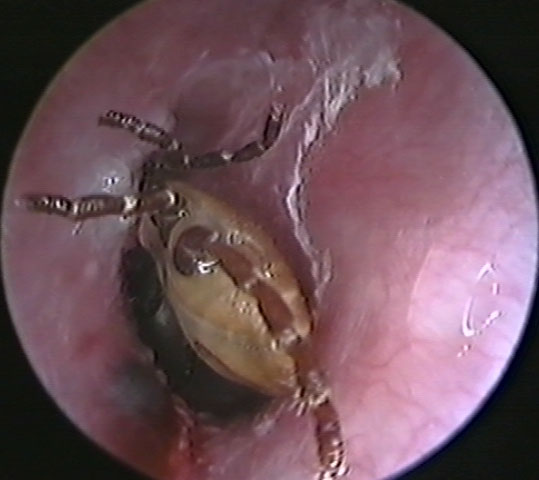
I quickly stumbled upon the ENT USA site, which is both informative and chock-full of revolting photos depicting objects in the ear canal -- objects that, by all rights, should not be there. I've inserted a few, um... favorites (?!) below. 

You've heard of the infamous deer tick, now witness the glory of the EAR tick!
It might not infect you with lyme disease, but it is extremely lethal to your sex life. 


I'm voting to replace the old adage "packed like a can of sardines" with the endearing quip, 
"all tucked-in like a warm bundle of ear maggots." Who's with me?


"This ear ache is killing me! What to do, what to do?... I know!--I'll grab one of my ciprofloxacin tablets, grind it up, and toss the powder in there. That outta make me right as rain!"


That's just a small sample of the fun in the ENT gallery, which includes among many other entries, photos of mastoid fistula, adenocystic carcinoma, and fungal infections of the ear. It's enough to make the most stoic Ferengi go wobbly in the knees with abject horror and despair. Enjoy now, thank me later. 


Thursday, May 17, 2012

WORMBOOK


An excellent online resource for studying C. elegans and other nematodes: 


Sunday, April 1, 2012

HAITI

Haiti, with all of its misfortune -- the atrocious sanitary conditions, profound socioeconomic disparity, and recent natural disasters -- serves as an ideal case study for epidemiologists. The U.N.'s ongoing role there provides an example of how organizational interaction can severely affect the health of a population, for better or worse.   

Global Failures on a Haitian Epidemic

Infectious Diseases of Haiti (E-Book)


>